



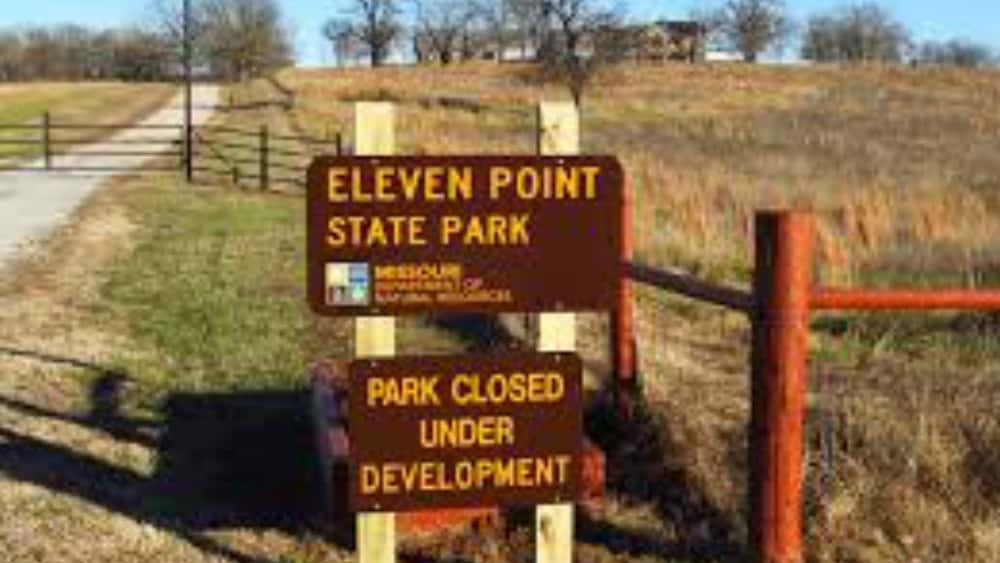
A lawsuit has now been filed in response to a court’s decision last week on the court case concerning 4200 acres along the 11-point River that was designated for the park. Last week ECNN reported that The State board of appeals had ruled in favor of State Attorney General Eric Schmidt, saying there will not be a sale of the property. Respondents have now motioned for rehearing or in the alternative for transfer to the Missouri Supreme Court. You can view the motion at our below.
IN THE
MISSOURI COURT OF APPEALS
SOUTHERN DISTRICT
VAN McGIBNEY, et al., )
)
Plaintiffs/Respondents, )
)
- ) Case No. SD36846
)
MISSOURI DEPARTMENT OF )
NATURAL RESOURCES, )
)
Defendant/Appellant. )
RESPONDENTS’ MOTION FOR REHEARING OR, IN THE
ALTERNATIVE, FOR TRANSFER TO THE MISSOURI SUPREME COURT
Respondents, by their counsel, move for the Court for rehearing or, in the alternative, for transfer of this case to the Missouri Supreme Court pursuant to Rules 84.17(a)(1) and 83.03. This Motion is timely filed under the applicable Rules. In support of the Motion, Respondents state:
Introduction
In their Response Brief and at oral argument, Respondents outlined that this appeal involved two separate cases: 1) the trial court’s Judgment, which was based upon evidence and testimony adduced at trial and 2) a hypothetical exercise in sematic gymnastics to justify Appellant DNR’s decision to acquire land for “public use” that the public is precluded from using by federal law.[1] In its Opinion (attached as Exhibit A), this Court overlooked the evidence upon which the trial court based its decision and substituted its judgment of the “facts,” many of which are not supported by any evidence. In addition, this Court “scoured the record” and went outside the record on appeal in search of support for its new “facts” and, thereby, took on the role of “advocate” in a case before it. In other words, this Court adopted a new standard of review in which trials are no longer important and can be tossed aside sua sponte. This new standard is directly contrary to well-established Missouri law as articulated in this Court’s recent decision in Est. of Collins by & through Collins v. Collins, No. SD 37185, 2022 WL 2128080, at *5 (Mo. Ct. App. June 14, 2022), reh’g and/or transfer denied (July 1, 2022) Finally, even if the Court uses its own erroneous facts and inferences, the Opinion unlawfully expanded Appellant DNR’s statutory authority to own vast areas of land that no one can use as a “park” simply because the view from the adjoining property is pretty. As outlined herein, the unprecedented deviation from the record and law that this Court took to reach its Opinion must be corrected, or the case should be transferred to the Missouri Supreme Court.
- Motion for Rehearing
- This Court should rehear this case pursuant to Rule 84.17(a) because its
Opinion contains material matters of law and fact overlooked or misinterpreted by the Court.
- For simplicity, Respondents will address the erroneous Statements/“Facts”
first. This following is not an exhaustive list of errors of fact and/or law contained in
the Court’s Opinion. They, however, are the most egregious errors upon which the Court seemingly relied to reach its decision.
- Erroneous Statements/“Facts” in this Court’s Opinion:
Erroneous Statement/”Fact” #1 – “The circuit court found the action of DNR unlawful, arbitrary and capricious and ordered DNR to divest itself of ownership of Eleven Point State Park.” (Opinion, p. 1)
This is the second sentence of the Court’s Opinion and is blatantly false. The trial court never ordered that Appellant DNR divest itself of the “Eleven Point State Park.” Instead, the trial court ordered Appellant DNR to divest itself of the portion of the park encumbered by the Scenic Easement, which represents approximately fifteen percent (15%) of the park. (Judgment, p. 8, attached hereto as Exhibit B)
As this Court may know, this case has garnered a level of media attention. One of the attorneys who submitted a brief in this case co-authored an “editorial” that referred to the trial court as “a solitary judge in the wilderness making speculative decisions about what might or might not happen in the future . . .”[2] The error on the first page of the Courts’ Opinion, which greatly expands the scope of the trial court’s Judgment, feeds this narrative. The impact of this false statement also highlights the myth upon which the Court’s Opinion rests: namely, that Appellant DNR will not permit the public to access the portion of the park encumbered by the Scenic Easement. If this myth were true, the trial court’s Judgment would have no impact on the Eleven Point State Park. Appellant DNR could continue to operate the park and have patrons enjoy “the views from the high ground on the west side of the Park. . .” (Opinion, p. 4) In other words, the trial court’s Judgment would have no impact on the “use” of the Eleven Point State Park and certainly would not require that the entire park be “divested.”
Erroneous Statement/“Fact” #2 — “The USFS supported DNR’s purchase of the former Pigman Ranch properties to create a state park, including the fifteen percent covered by the easement.” (Opinion, p. 3)
This “fact” was taken directly from page 14 of Appellant’s Brief. As set forth in detail in Respondents’ Motion to Strike Appellant’s Brief, this “fact” is not true in any sense. First, with respect to the trial testimony cited by Appellant DNR as proof of this “fact”, the actual answer is:
“Q. Okay. And, in fact, did the — based on that feedback, did the Forest Service indicate whether or not they would support the purchase of the park, easement included?
- I don’t know that.” (Tr.131:20-23)
Second, the only other evidence of this “fact” in the record is the Nightingale Letter, which makes clear any state park would be subject to the strict prohibitions contained in the Scenic Easement. (Tr.164:24-165:6) Indeed, the trial court specifically rejected this “fact” on the record at trial:
“MS. SCHUETZE: The easement holder gave a letter — the Nightingale letter that says, ‘We support the purchase of this property as a park.’
THE COURT: Yeah. The Nightingale letter doesn’t say anything. It says, ‘We support the purchase. Do a great job. But, by the way, do not violate any of the scenic easement restrictions in any way or respect.’” (Tr. 243:19-23)
Accordingly, it is hard to explain how Appellant included this “fact” in its Brief, and even harder to understand how this false statement found its way into this Court’s Opinion. This is especially true given the governing standard of review, which requires the Court to “view the evidence and the reasonable inferences drawn from the evidence in the light most favorable to the judgment, disregard all evidence and inferences contrary to the judgment.” Collins, 2022 WL 2128080, at *5.
Erroneous Statement/“Fact” #3 — “Respondents testified about the great scenic and cultural value of the property.” (Opinion, p. 5 and 9)
First, it is worth noting that this “fact” was so important that the Court included it twice in its Opinion. Second, and more importantly, the “fact” was never raised by Appellant in its Brief or Reply Brief, and it certainly was not raised by Respondents. In other words, this Court must have “scoured the record” to obtain this “fact,” which is the type of “advocacy” generally prohibited. Carmen v. Olsen, 611 S.W.3d 368, 373 (Mo.App.E.D 2020)
Moreover, this Court’s independent “finding of fact” is wrong. The actual testimony related to any “cultural” aspect of the property was provided by Mrs. McGibney, who testified:
“Q: And is cattle farming up and down the Eleven Point River, is that a historical quality –
A: Yes.
Q: — and a culture quality of the Eleven Point River?
A: Yes, it is.” (T.T. 202)
To extrapolate this testimony to make the above-quoted “finding of fact” would violate any standard of review. In short, if this Court is now creating its own “facts” from the record, it should be held to the same standard as the trial court; namely, a fact must be supported by “substantial evidence.” See Collins, 2022 WL 2128080, at *5.
Erroneous Statement/“Fact” #4 – “Essentially, this case is about whether DNR, through its Division of State Parks, has the authority to acquire, hold, and maintain land as a state park when a portion of the land is encumbered by a federal easement restricting the public’s access.” (Opinion, p. 7)
This statement epitomizes the Court’s failure to address the facts and evidence adduced at trial and the findings made by the trial court. This case is about whether Appellant DNR has the authority to acquire encumbered land while intending to allow the public access over the land protected by a Scenic Easement. As outlined below, the Court overlooked all the facts and evidence adduced at trial that directly contradicts this erroneous statement and which formed the basis of the trial court’s Judgment.
Erroneous Statement/“Fact” #5 — “It is undisputed that both properties have recreational and cultural value due to their scenic nature, distinctive characteristics, and wild and natural features.” (Opinion, p. 9)
This “finding of fact” is both unsupported and incorrect. In fact, Appellant acknowledged that this was a disputed issue in its Reply Brief. (Appellant’s Reply Brief, p. 13) The importance of this erroneous “fact” is outlined below as the Court now has given Appellant DNR the authority to acquire, own and maintain property that that public cannot use as a “state park” simply because the view from adjacent land is pretty.
Erroneous Statement/“Fact” #6 – “In fact, DNR’s regulations created a system that allows the DNR to prohibit the public’s physical access onto portions of its state park properties for a variety of reasons.” (Opinion, p. 10)
Here, the Court “conflated” the terms “limited access” with “no access.” The Court notes three regulatory provisions that allow “limited access” to park properties and the ability to limit “recreational” activities. These provisions, of course, do not provide for “no access” of park property; especially with respect to over five (5) miles of river frontage. 10 CSR 90-2.040(6); 10 CSR 90-2.030(27(A); 10 CSR 90-2.030(27(C).
To further “conflate” these terms, the Court used three examples of parks that allegedly restricts public access: Ha Ha Tonka State Park, Onondaga Cave State Park and Orchid Valley Natural Area. (Opinion, pp. 11-12) As set forth below, all of these parks permit public access. In other words, the Court’s own examples again “conflated” the terms “limited access” with “no access.”
Erroneous Statement/“Fact” #7 — “Eighty-five percent of the Eleven Point State Park is unencumbered by the Scenic Easement, enabling the public to view the river and easement lands from the unencumbered land, which is similar to the public’s ability to view the Ha Ha Tonka State Park ruins without being permitted to physically enter them. There are other state parks in Missouri, including Onondaga Cave State Park and Orchid Valley Natural Area, with restricted areas or areas otherwise closed to the public.” (Opinion, pp. 11-12)
The actual testimony from the trial is as follows:
“A: For example, the Onondaga Cave is very restricted in access to tours only. . . We have Orchid Valley Natural Area, a very spectacular natural area at Hawn State Park which is a zone of the park in which public access is restricted, requiring that anyone accessing the site checks in with the park, registers with the park, is instructed on how to enjoy the site without damaging the very sensitive flora that’s there and things of that nature. (T.T. 113)(emphasis added)
Finally, there was no trial testimony related to the Ha Ha Tonka State Park. Instead, Appellant made unsupported assertions related to the Ha Ha Tonka State Park in its Brief. (Appellant’s Brief, pp. 45, 46 and 52) Since Appellant and now this Court have relied on matters outside the record on appeal, Respondents would like the Court to consider that this “fact” also is erroneous.
The ruins at Ha Ha Tonka State Park were open to the public. In fact, the Court can go to the Missouri State Park’s website and see a video and pictures of patrons joyfully walking and crawling through the ruins.[3] In June 2017, some of the ruins were deemed unstable, which caused a safety issue. The ruins were temporarily closed so that the ruins could be stabilized. Appellant DNR budgeted $1.3 million to restore the ruins so that the public can again access and enjoy them.[4] Normally, this type of discussion would be inappropriate; however, this Court expanded the scope of its authority and relied upon “facts” outside the record, so those “facts” should at least be correct.
Erroneous Statement/“Fact” #8 – “DNR’s intended use of the encumbered portions of the Eleven Point State Park property for preservation and restoration purposes is supported by the Scenic Easement and the Act.” (Opinion, p. 14)
This is the myth upon which the Court’s Opinion is based. As set forth in Respondents’ Brief and the trial court’s Judgment, Appellant DNR intends to allow the public to “use” the portions of the park encumbered by the Scenic Easement. (Tr.26:23-27:23; 30:22-31:7; 33:10-15; 46:12-47:3; 47:19-49:6;171:6-17; 179:10-17) Indeed, Appellant DNR’s representative freely admitted that allowing the public access to/from the Eleven Point River over the encumbered property was a “significant purpose” of the park. (Tr.48:20-49:6) The trial court acknowledged this when it found: “the purpose of the park, which bears the name Eleven Point River Park, was for access, use, and enjoyment of the Eleven Point River . . .” (Judgment, pp. 6-7)
Somehow, despite being briefed and argued, this Court “overlooked” all of this. Indeed, the Court failed to mention any of this evidence in its Opinion. Instead, this Court found Appellant DNR’s “intended use” was limited to “preservation and restoration.” As set forth herein, the Appellant DNR’s true “intent” was a cornerstone of the case. Respondents adduced substantial evidence that Appellant DNR intended to allow the general public access to/from the Eleven Point River over the portion of the park encumbered by the Scenic Easement. The trial court accepted this substantial evidence and based the Judgment upon it. This finding was not even challenged by Appellant. Nevertheless, this Court overlooked this evidence and the trial court’s unchallenged finding, and made its own “findings of fact” upon which to base its decision.
Importantly, without this unsupported “finding of fact,” the Court’s entire Opinion becomes illogical. In other words, would the Opinion withstand scrutiny if Appellant DNR intends to allow the public access to/from the Eleven Point River from the park in violation of federal law? The obvious answer is: “No.”
- “Overlooked or Misinterpreted” Law in this Court’s Opinion.
- In addition to the erroneous Statement/”Facts” contained in its Opinion, the
Court also made at least three improper legal analyses to reach its decision.
Overlooked Standard of Review
In Est. of Collins by & through Collins v. Collins, No. SD 37185, 2022 WL 2128080, at *5 , this Court held:
“In a bench-tried case, the judgment will be affirmed ‘unless there is no substantial evidence to support it, unless it is against the weight of the evidence, unless it erroneously declares the law, or unless it erroneously applies the law.’ Murphy v. Carron, 536 S.W.2d 30, 32 (Mo. banc 1976). We view the evidence and the reasonable inferences drawn from the evidence in the light most favorable to the judgment, disregard all evidence and inferences contrary to the judgment, and defer to the trial court’s superior position to make credibility determinations. Houston v. Crider, 317 S.W.3d 178, 186 (Mo. App. S.D. 2010). ‘[T]he trial court’s judgment is presumed valid, and the burden is on the [Estate] to demonstrate its incorrectness.’ McElvain v. Stokes, 623 S.W.3d 769, 774 (Mo. App. W.D. 2021) (internal citation and quotation omitted).
*******
Under our standard of review, we are required to disregard inferences contrary to the judgment and defer to the trial court’s assessment of the evidence. Estate of Elder v. Estate of Pageler, 564 S.W.3d 742, 748 (Mo. App. S.D. 2018). Because the Estate’s point and argument claiming the trial court misapplied the law is premised upon and constructed around purported facts and inferences that we are required to disregard upon appellate review, it necessarily lacks any meritorious analytical foundation, support or persuasiveness for our determination that such a claimed legal error occurred. Id. at 748-49.
Moreover, by relying upon the purported facts and inferences contrary to the judgment in its argument, the Estate pivots from the misapplied-the-law challenge raised in its point to a not-supported-by-substantial-evidence challenge. See Missouri Ozarks Radio Ntwk. Inc. v. Baugh, 598 S.W.3d 154, 170 (Mo. App. S.D. 2020). To sustain such a challenge requires an appellant to follow certain analytical steps. Houston, 317 S.W.3d at 187. ‘A]dherence to this analytical framework is mandatory … because it reflects the underlying criteria necessary for a successful challenge–the absence of any such criteria, even without a court-formulated sequence, dooms an appellant’s challenge.’ Robinson v. Loxcreen Co., Inc., 571 S.W.3d 247, 251 (Mo. App. S.D. 2019) (quoting Nichols v. Belleview R-III School Dist., 528 S.W.3d 918, 928 (Mo. App. S.D. 2017)). It requires the party challenging the judgment to: (1) identify a challenged factual proposition, the existence of which is necessary to sustain the judgment; (2) identify all of the favorable evidence in the record supporting the existence of that proposition; and, (3) demonstrate why that favorable evidence, when considered along with the reasonable inferences drawn from that evidence, does not have probative force upon the proposition such that the trier of fact could not reasonably decide the existence of the proposition. Houston, 317 S.W.3d at 187. The Estate ignores all three steps. Stating only the evidence favorable to its own position without demonstrating why the trier of fact could not reasonably have decided otherwise is fatal. This Court may not substitute its judgment on the evidence when the evidence before the trial court could have resulted in two opposite findings and we are bound by the trial court’s credibility findings. The Estate’s failure to follow Houston’s analytical framework deprives its argument of any analytical or persuasive value. See Missouri Ozarks Radio Ntwk. Inc., 598 S.W.3d at 170.”
Just forty-five (45) days later, this Court chose not to follow this well-articulated standard and created a new one: all evidence supporting the trial court’s Judgment can be ignored, the trial courts’ findings of fact (which were not challenged on appeal) can be sua sponte disregarded, all inferences are in favor of the Appellant, and this Court can conduct its own search of matters inside and outside the record on appeal to make its own “findings of facts” upon which to base its decision.
“The function of an appellate court is not to serve as an advocate for the parties on appeal, and this Court must carefully safeguard its role as a neutral adjudicator.” D.R.F. v. D.L.S., 640 S.W.3d 484, 486 (Mo.App.E.D. 2022)(citation omitted) In this case, this Court sua sponte substituted its own judgment on contested issues of fact, disregarded the trial court’s findings on those contested issues, granted every inference in favor of the Appellant, and created its own erroneous “facts” upon which to base its decision. This new standard should not be allowed as it violates the most basic principles of judicial review.
The Court misinterpreted Appellant DNR’s statutory authority.
In addition, even if the Court overlooks the evidence and the trial court’s findings based thereon and, instead, relies upon its unsupported “findings of fact” that Appellant DNR can and will prohibit the general public from using the portion of the park encumbered by the Scenic Easement, its decision still fails legal scrutiny. As set forth above, this Court made several erroneous statements related to the “cultural” value of the Eleven Point State Park. Under the section of the Opinion titled “Cultural and Scenic Value of the Eleven Point State Park” this Court stated: “Park visitors will be able to behold the expansive vista of the Eleven Point River and the lands encumbered by the Scenic Easement from many portions of the park not subject to the easement.” (Opinion, p. 9) Essentially, the Court held that property has “cultural value” if one hilltop has a good view.
- 253.040 RSMo. enables the Department of Natural Resources “to accept by purchase, lease, donation, agreement or eminent domain, any lands, or rights in land, sites or facilities which in its opinion should be held, preserved, improved and maintained for park or parkway purposes.” §253.010 RSMo. defines “park” as “any land, site or object primarily of recreational value or of cultural value because of its scenic, historic, prehistoric, archeological, scientific, or other distinctive characteristics or natural features.” (emphasis added) The same statute also defines “parkway” as “an elongated area of parkland, usually contiguous to a pleasure driveway and often containing recreational areas.” Id.
The Court’s unsupported finding of a “cultural” element to the portion of the Eleven Point State Park encumbered by the Scenic Easement is a fundamental basis for its decision. As the statutory framework provides, Appellant DNR has the authority to acquire, own and maintain property as a state “park” that is “primarily of recreational value or of cultural value.” Id. As the Court seemingly agreed that the property at issue would have no “recreational” value if the public cannot access it, the Opinion rests upon the “cultural” side of the statute. As set forth herein, there was no evidence of a “cultural value” of the property other than being related to cattle farming. Accordingly, as discussed above, this Court crafted a “cultural value” based solely upon a portion of the property having a pretty view. Moreover, if we use the Court’s unsupported “finding of fact” that the public will have “no access” to the encumbered portion of the “park,” this pretty view must come from some other place. (It would be hard for the public to enjoy a view from property to which they have “no access”.)
In sum, the Court has determined that Appellant DNR may acquire, own and maintain land for “park purposes” that the general public is precluded from using by federal law. In this case, the hypothetical “no access” park contains approximately 625 acres stretching along five (5) miles of river frontage. As there now are no limits placed upon DNR’s unbridled ability to acquire, own and maintain park property that no one can “use,” the next “park” could be much larger. In other words, this Court has granted Appellant DNR authority to own vast expanses of land as “parks” that are not opened to the public simply because Appellant DNR believes that the view from the adjacent property is pretty. Such a judicial delegation is directly contrary to Appellant DNR’s statutory authority and the Missouri Supreme Court’s decision in State ex rel Wagner v. St. Louis Port Authority, 604 S.W.2d 592, 597 (Mo. Banc 1982).
The Court overlooked Appellant DNR’s contractual obligations.
Finally, the Court’s Opinion does not address Appellant DNR’s contractual obligations to allow the public to “use” the property. While the Court notes that Appellant DNR accepted the property by dedications, the Court then fails to analyze the meaning of those dedications. Specifically, as outlined above, the Court (based solely upon its erroneous factual findings) held that Appellant DNR could restrict access to the portion of Eleven Point State Park because “DNR is authorized to prohibit the public from entering portions of the park encumbered by the Scenic Easement to accomplish its stated goals of preserving and restoring the encumbered parklands to their natural scenic qualities.” (Opinion, p. 11).
The dedications read:
“The property is hereby dedicated to public use and conveyed to the Missouri Department of Natural Resources only for the following purposes and none other: for public use as a state park and for natural resource restoration and preservation.” (Exhibit 9, Appellant’s Appendix A109)(emphasis added)
****
“The property is hereby dedicated to public use and conveyed to the Missouri Department of Natural Resources only for the following purposes and none other: for public use as a state park and for natural resource restoration and preservation.” (Exhibit 12, Appellant’s Appendix A113)(emphasis added)
Accordingly, if the Court’s hypothetical “public purpose” (instead of “public use”) of the property is substituted, the dedications would effectively read: “for public use as a state park for preserving and restoring the encumbered parklands to their natural scenic qualities and natural resource restoration and preservation.” Such an alteration to the plain meaning of the dedications would never pass judicial scrutiny.[5] Accordingly, as the trial court recognized, Appellant DNR has a contractual obligation pursuant to the dedications to allow the public to “use” the property. Given the dedications, Appellant DNR has no way of preventing the public from “using” the property at issue, making this Court’s “public purpose” discussion illogical and irrelevant.
- Alternative Motion to Transfer to the Missouri Supreme Court
- In the alternative to their Motion for Rehearing, Respondents request that this
cause be transferred to the Missouri Supreme Court pursuant to Rule 83.02. There are several matters of general interest or importance on which the Missouri Supreme Court can provide guidance to litigants, governmental agencies and lower courts.
- Whether Appellate Courts can disregard the evidence and all reasonable inferences therefrom that supports a trial court’s Judgment and make its own factual findings from matters inside and outside the record and, if so, whether those facts must be supported by substantial evidence.
As outlined above, the Court made numerous erroneous statements/”facts” in its Opinion. These erroneous statements/“facts” overlooked the evidence in support of the trial court’s Judgment, disregarded the trial court’s findings and gave every inference in favor of the Appellant. In other words, this Court overturned bedrock principles of appellant review. See Collins, 2022 WL 2128080, at *5. Moreover, some of these “facts” were supported by matters outside the record on appeal. Accordingly, the Missouri Supreme Court could provide guidance on if (and when) an Appellate Court can sua sponte make its own findings of fact and whether those new findings must be supported by substantial evidence.
- Whether property has a “cultural value” such that it can be a state park because the adjacent property has a good view.
As outlined above, this Court granted Appellant DNR authority to acquire, own and maintain property that the general public cannot use as a “state park” simply because a portion of it has a good view. This holding seemingly violates the agency’s enabling statutes and the requirement that: “For expenditures of public funds to have a public purpose, it must be for support of the government or for some of the recognized objects of government, or directly to promote the welfare of the community, and in order for public purpose to be found on the ground that there flowed from the expenditure some benefit or convenience to the public, the benefit or convenience must be direct and immediate, and not collateral, remote or consequential.” State ex rel Wagner, 604 S.W.2d at 597. The Missouri Supreme Court could provide guidance on whether DNR’s statutory authority allows it the discretion to own and maintain vast areas of land as a “state park” even though the public cannot access it based solely upon the view from a nearby hilltop.
- Whether Appellant DNR has a contractual obligation to allow the public to “use” the property.
As outlined above, this Court overlooked the dedications. As a result, the dedications now effectively read: “for public use as a state park for preserving and restoring the encumbered parklands to their natural scenic qualities and natural resource restoration and preservation.” The Missouri Supreme Court could provide guidance on whether this Court can alter the dedications in such a manner.
WHEREFORE, Respondents request that the Court order a rehearing in this cause or, in the alternative, transfer this case to the Missouri Supreme Court.
Respectfully submitted,
The Kirby Law Firm, PC
By /s/ Devin S. Kirby______
Devin S. Kirby, #56609
The Kirby Law Firm, P.C.
100 Jefferson St.
Doniphan, Missouri 63935
Telephone: (573) 996-4747
Facsimile: (573) 996-5402
kirbylaw@windstream.net
Attorneys for Respondents
[1] Violation of a Scenic Easement governed by the Wild and Scenic Rivers Act is a crime. 16 U.S.C. §551; 16 U.S.C. §1283(a); see U.S. v. Richard, 636 F.2d 236 (8th Cir. 1980)
3 “Protect our Eleven Point State Park” dated October 1, 2020 was published in the Springfield Newsleader (and various other publications)(attached as Exhibit C).
[3] Go to website https://mostateparks.com/park/ha-ha-tonka-state-park and select “Park Video” and “Photo Gallery.”
[4] As covered by KY3 News on July 12, 2019 in its story: “CELEBRATE THE OZARKS: Ha Ha Tonka Castle Ruins”. (attached as Exhibit D) See also Missouri State Parks/Lake Expo story dated October 1, 2018: “Ha Ha Tonka Castle Restoration Could Begin in 2019, But Will Fence Ever Be Removed?” (attached as Exhibit E)
[5] Imagine a prosecutor trying to prove a park patron “trespassed” on the hypothetical “no access” portion of the park given the scope of the dedications.
For a Complete Look at All the Latest News Click Link Below